EasyGold Journal
How to Tell If Your Gold Is Real: 7 At-Home Tests That Actually Work
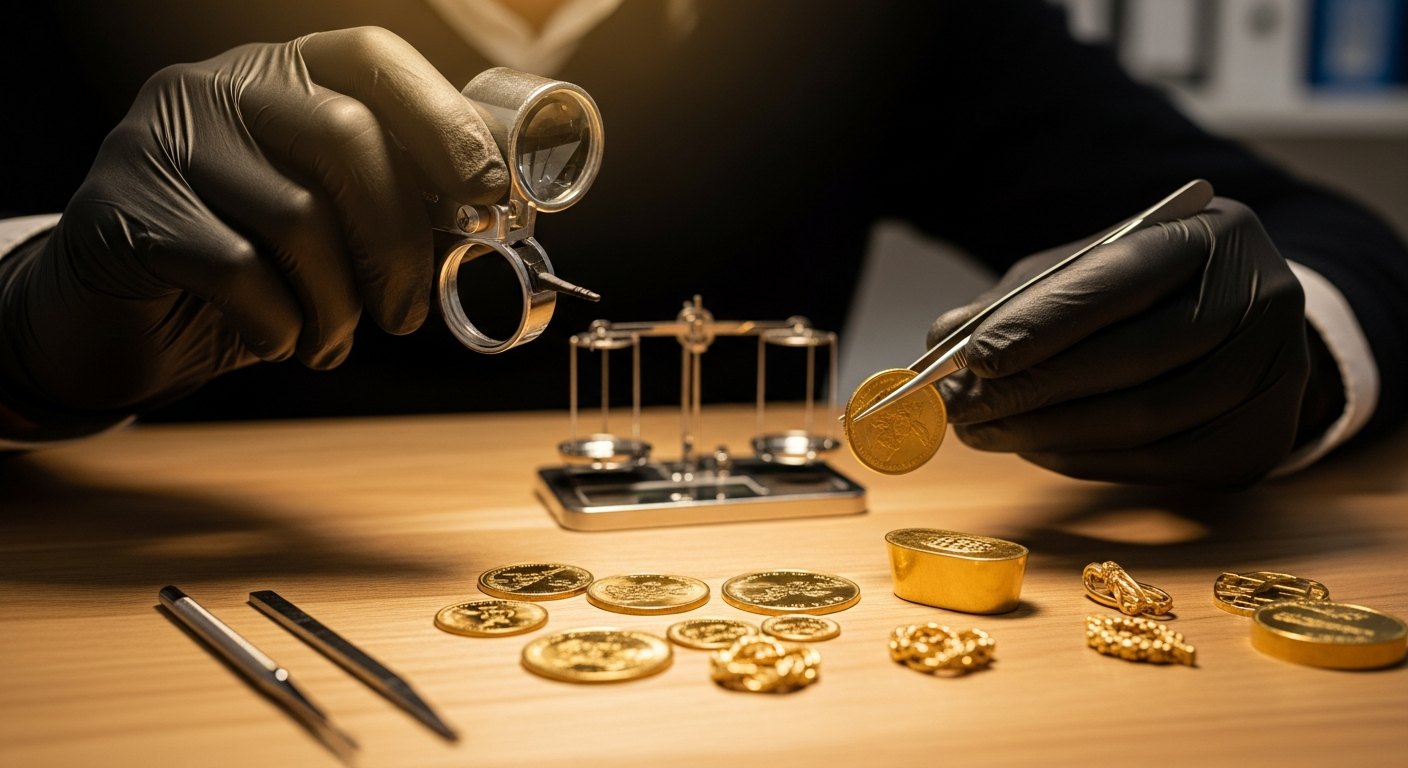
Most Australians have a small stash of jewellery they've never thought about — old chains, broken earrings, a ring from a relative. Before you decide whether it's worth selling, it helps to know whether it's gold at all.
Here are seven simple checks you can do at the kitchen table.
1. Look for a hallmark
Almost all real gold made in the last century carries a small stamp showing its purity. Common Australian and international marks include:
- 999 or 24K — pure gold (rare in jewellery)
- 916 or 22K — 91.6% gold
- 750 or 18K — 75% gold
- 585 or 14K — 58.5% gold
- 375 or 9K — 37.5% gold (the most common in Australian jewellery)
If you see GP, GF, HGE or EPNS, it's plated, filled, or silver-plate — not solid gold.
2. The magnet test
Real gold is not magnetic. Grab a strong fridge magnet and hold it close to the item. If the piece jumps or sticks, the core is iron, steel or a magnetic alloy.
The magnet test rules out fakes quickly, but it can't confirm gold on its own — many non-magnetic metals (brass, copper, lead) will also pass.
3. The skin test
Hold the item in your closed hand for 30 seconds. If your skin under it turns green, black or grey, it's almost certainly plated or low-quality. Real gold doesn't react with skin oils.
4. The water (density) test
Real gold is exceptionally dense — about 19.3 g/cm³. Fill a measuring jug with water, weigh the item dry, then drop it in and measure how much water it displaces in millilitres. Divide weight (g) by displacement (ml).
A result close to 19 suggests high-purity gold. A result of 11–14 suggests plated or low-karat. A result below 10 is very unlikely to be gold.
5. The ceramic plate test
Drag the item lightly across an unglazed ceramic tile (the back of a bathroom tile works). Real gold leaves a gold streak. Pyrite ("fool's gold") and brass leave a black or green streak.
Skip this on jewellery you care about — it can scratch the piece.
6. The vinegar test
Place a few drops of household vinegar on an inconspicuous spot. Real gold won't change colour. Plated items will dull, darken or turn green within a minute.
7. The "sound" test (for coins and bars)
Real gold makes a long, soft, ringing sound when tapped against another coin — almost like a small bell. Fakes tend to clunk dully. This is a favourite among coin collectors but takes a trained ear.
What to do next
If your items pass most of these tests, they're worth getting professionally evaluated. Home tests are useful for ruling out obvious fakes — they can't tell you the karat or the precise weight of pure gold inside an item.
A professional XRF (X-Ray Fluorescence) test is non-destructive and gives an exact reading in seconds. That's what we use on every item that arrives at our Gold Coast facility.
If you'd like a no-obligation valuation, order a free, insured Gold Kit and we'll tell you exactly what you have — and what it's worth — within 48 hours of receiving it.